

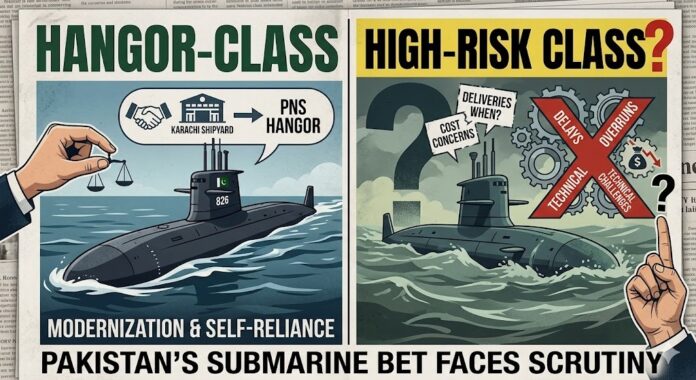
Pakistan commissioned PNS Hangor on 30 April 2026 in Sanya, China, with President Asif Ali Zardari and Chief of Naval Staff Admiral Naveed Ashraf presiding over a ceremony that offered the programme’s clearest statement yet of official ambition. The Hangor class is being projected as the centrepiece of Pakistan’s naval modernisation — extending underwater endurance, complicating India’s anti-submarine calculus, and signalling strategic resolve in an increasingly contested Arabian Sea. None of that ambition is implausible on paper. What is limited, and conspicuously so, is the public evidence that the programme as currently constituted can deliver it.
The propulsion question is the most technically significant unresolved issue. The Hangor class was designed around German MTU 12V 396 marine engines, but following a 2021 discovery that MTU engines had been used on Chinese warships in violation of the EU arms embargo, Germany blocked their export to China.
China offered its domestically produced CHD620 as a substitute, and Pakistan accepted. Submarine engines are not interchangeable components. Their reliability under sustained operational pressure — across years, across deployments, across the kinds of conditions that press releases do not describe — is the kind of thing that gets tested in practice.
Thailand’s navy, facing the same substitution on its parallel S26T contract, initially declined to approve the CHD620 because the engine had not been used in any Chinese submarine, with the Thai Navy commander stating: “Without anyone guaranteeing its quality, we can’t be assured that it is really good.”
China subsequently bench-tested the engine for more than 6,000 hours, after which Thailand conditionally accepted it. The Royal Thai Navy’s formal conclusion was that the CHD620 “demonstrates a quality comparable to the original engine, in accordance with the performance limits specified in the agreement.” That is a contracted-standard finding produced after a formal evaluation process.
Pakistan has offered no equivalent public record of assessment — no independent validation, no comparable technical documentation — and no publicly confirmed operational navy, excluding possible experimental or prototype use, is known to have adopted the CHD620 for active submarine service. Whether these submarines are reliably powered remains, on the available evidence, an open question.
The dependency problem compounds the propulsion question. Every major Hangor system — propulsion, electronics, weapons, spare parts — traces back to China, making Pakistan’s submarine arm structurally dependent on Beijing’s continued material and technical support.
If China withholds support — even temporarily, even for reasons unrelated to the bilateral relationship — Pakistan’s submarine operational readiness degrades. This is a vulnerability that any adversary’s strategic planner would note.
The technology transfer to Karachi Shipyard is routinely cited as evidence that Pakistan is developing genuine indigenous capability. The distinction worth drawing is between the ability to assemble components under supervision — which the programme is demonstrably building — and the capacity to design, modify, or fundamentally sustain the platform without the original supplier’s involvement.
The steel cutting ceremony for the fifth boat, the first to be assembled at KSEW, took place in December 2021, and the keel laying for the sixth was held in February 2025 — a pace that raises legitimate questions about how deeply the institutional knowledge required for genuine self-sufficiency is being embedded.
Building submarines to Chinese specifications is not the same as understanding them. The distinction matters enormously over a multi-decade operational horizon.
Then there is the matter of the schedule. The original bilateral plan envisaged Pakistan receiving all eight submarines across a delivery window running from 2022 to 2028 — not, as often characterised, a commitment to have all eight operational by a single 2028 deadline.
Of the four China-built boats, only PNS Hangor has been commissioned; PNS Shushuk, PNS Mangro, and PNS Ghazi completed their launches across 2025 and remain in late-stage sea trials pending their own handovers. Full fleet induction is now expected between 2028 and 2030 — a meaningful slide from original projections, though well short of the 2033–34 timelines sometimes cited, which are not supported by current open-source analysis.
What Pakistan has not done is formally acknowledge the schedule change, explain it, or offer a revised timeline on the record.
Export submarines consistently differ from their domestic counterparts in sensors, combat management systems, and acoustic quieting — and the Hangor, as an export-optimised derivative rather than the vessel China operates in its own fleet, is assessed by independent analysts as falling short of full Yuan-class performance standards. Pakistani officials have not contested that assessment with evidence.
Each of these issues, unresolved, limits confidence in the programme’s strategic returns. Together, they call into question whether the Hangor programme, as currently described and documented, delivers the deterrent and operational value being claimed for it. The submarines are real. The questions are not going away.
