

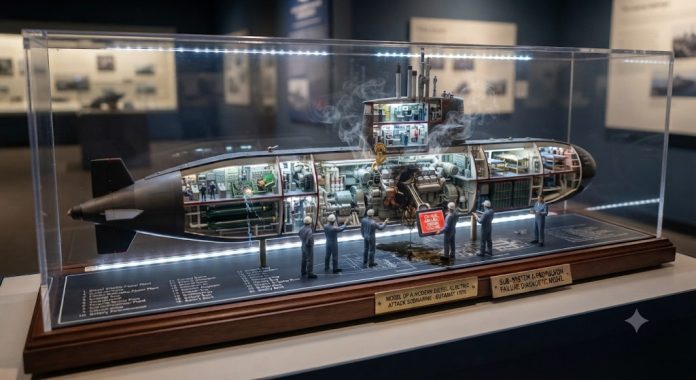
PNS Hangor, the first submarine of the Pakistan Navy’s Hangor class, was commissioned in Sanya, China, on April 30, 2026, and arrived in Karachi on June 11. The boat is a significant milestone for Pakistan’s underwater capabilities. Its commissioning has also drawn attention to a less visible component whose long-term performance is still unproven: the Chinese CHD620 diesel engine.
The Hangor class was designed around Germany’s MTU 396 engine, but Germany refused to approve export licences for it. China offered the CHD620, a domestically produced engine described as a licensed version of the MTU 396, as a substitute. Concerns about its reliability stem from its thin operational record. No Chinese operational submarine is publicly confirmed to use it, and the fact that China had to put the engine through a qualification process for Thailand suggests the PLA Navy has not used it on its own Type 039 boats.
Thailand, which ordered the S26T, a similar submarine, faced the same substitution and was initially reluctant to accept the CHD620 over quality and longevity concerns. China responded by bench-testing the engine for more than 6,000 hours and extending the warranty and maintenance support from two to eight years. The Royal Thai Navy then concluded that the engine’s quality was comparable to the original. Thailand’s cabinet approved the amended contract on August 5, 2025.
Extensive bench testing, however, does not guarantee long-term reliability. A test bench measures performance under controlled conditions and cannot replicate prolonged operations at sea. Durability, early wear and maintenance demands emerge only with sustained use.
Manufacturing quality is a further concern. Marine diesel engines require high-grade materials, and poor quality can cause parts to wear out quickly. In an April 2024 Defense News article, Aaron Amick, a former US Navy submariner who runs the Sub Brief website, described the CHD620 as essentially a copy of the MTU 396 made with inferior materials and inconsistent quality control. He said it performs well initially but then needs “near continuous repair after a few hundred hours of operation.”
The operating environment magnifies these weaknesses. Submarine equipment is exposed to heat, vibration and mechanical stress, and a small defect can escalate into a major failure. Repairs are also difficult because of where the engines sit inside the hull. Frequent engine faults would directly reduce the availability of Pakistan’s submarines. Time spent on inspection and repair is time not spent on patrols and crew training.
Pakistan may also depend on Chinese technicians for specialised engine repairs. If major repairs require Chinese personnel, specific diagnostic equipment or imported parts, Pakistan will struggle to carry them out independently, and boats could be kept out of service for long periods.
Ultimately, the Hangor programme will be judged by how many submarines Pakistan can keep operational. If the CHD620 needs frequent maintenance and servicing, the Navy may field fewer boats than it expected.
