

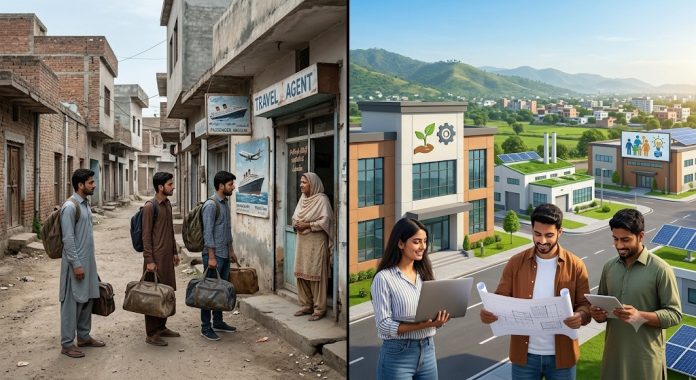
Mirpur has become the district in Pakistan-Occupied Jammu and Kashmir to lose people. Its young men leave on agents’ boats, and its economy lives on money from Britain. Jammu and Kashmir, meanwhile, builds factories, funds young entrepreneurs and keeps its talent at home.
In June 2023, a fishing trawler crammed with migrants sank off southern Greece. Days later, the commissioner of Mirpur division confirmed that about 50 young men from the Kotli area of Pakistan-Occupied Jammu and Kashmir (PoJK) had gone missing. They had left home three months earlier, and human traffickers from the Pakistani districts of Gujranwala, Gujrat and Mandi Bahauddin had arranged their journey. Those young men did not flee war. They fled a territory that offered them no future.
The Only District That Shrank
PoJK’s own census records the exodus. Mirpur’s population fell from 4.57 lakh in 2017 to 4.42 lakh in 2023, a decline of 0.42 per cent a year. No other district in the territory shrank. Population growth also slowed sharply in the neighbouring districts that send the most emigrants abroad: to 0.68 per cent a year in Kotli, 0.89 per cent in Sudhnoti and 0.91 per cent in Bhimber, against 1.25 per cent across PoJK.
A Dam, a Diaspora, a Dependency
A Pakistani dam deepened the exodus. In the 1960s, the Mangla reservoir flooded Mirpur’s fertile farmland and pushed displaced families abroad, swelling a migration to Britain that has never stopped. Today, an estimated 60 to 70 per cent of British Pakistanis in England trace their roots to PoJK, mostly to Mirpur, Kotli and Bhimber.
Mirpur now lives on their money. A local businessman estimated that relatives abroad send about $200 million a year to the district, because it has few jobs and little industry. “There is no large land holding, no industrial base, we are not on a good route,” he admitted. When sterling slumped after the Brexit vote, families began to receive money every two or three months instead of every month, and a local branch of a British bakery chain watched its sales fall by 30 per cent. An economy that depends on another country’s currency cannot plan its own future.
No Work at Home
Industry offers little alternative. Mirpur’s business leaders call it PoJK’s only industrial district, yet its industrial zone employs just over 4,000 people, and in July 2026 officials planned to move the district’s industries office to Muzaffarabad. Across PoJK, the government allocated just 0.71 per cent of its 2024–25 development programme to industries, sericulture, labour and minerals. Unemployment stands at 9.6 per cent, and at 19.1 per cent among women, according to a labour force survey from 2020–21 that the territory has not updated since.
PoJK mirrors a wider Pakistani flight. In 2025, 762,499 Pakistanis registered to work abroad, and in 2024 alone the country lost 3,642 doctors and 8,018 engineers to foreign employers.
Jammu and Kashmir: Jobs at Home
Jammu and Kashmir has chosen to create work on its own soil. Between 2019 and December 2024, entrepreneurs set up 1,984 new industrial units worth ₹9,606 crore, and those units created 63,710 jobs. Industrial investment reached a record ₹5,824 crore in 2025–26, more than 13 times the average before 2021. Under the ₹28,400-crore New Central Sector Scheme, officials have cleared 971 more units that should create 51,897 jobs.
The Union Territory also backs young people who want to build their own businesses. By September 2026, banks under Mission YUVA had disbursed ₹1,826 crore to 32,665 borrowers, and 13,597 new enterprises had opened their doors. The programme has trained 36,474 people and aims to support 50,000 enterprises in 2026–27. Earlier self-employment schemes helped create 40,778 enterprises employing 1.16 lakh people, and unemployment fell from 6.7 per cent in 2019–20 to 6.1 per cent in 2023–24.
Women share in the gains. By March 2026, 2,52,867 women in Jammu and Kashmir had become “Lakhpati Didis”, with household incomes of at least ₹1 lakh a year. Per capita income across the Union Territory grew by 8.81 per cent a year between 2019–20 and 2024–25, faster than in Punjab, Delhi, Himachal Pradesh and Haryana.
Staying or Leaving
A homeland proves its worth when its young people can build a life without leaving it. Jammu and Kashmir now offers factory jobs, start-up loans and rising incomes at home, for men and women alike. PoJK offers a shrinking city, a cheque from Britain and, for the desperate, a seat on a trafficker’s boat. Mirpur has spent six decades exporting its people. Its rulers have still given them no reason to stay.
