

Training has emerged as a key pillar of India-Mauritius maritime ties, with 516 Coast Guard personnel trained by the Indian Navy. These efforts directly support the security of Mauritius’ blue economy, which remains central to its development.
When Cyclone Chido moved through the Indian Ocean region in December 2024, India was among the first countries to mobilise relief. Supplies reached affected areas quickly. Technical support followed. The response was rapid not because it was improvised, but because the relationships, communication channels, and institutional trust that make rapid responses possible had been built, methodically, over the preceding years.
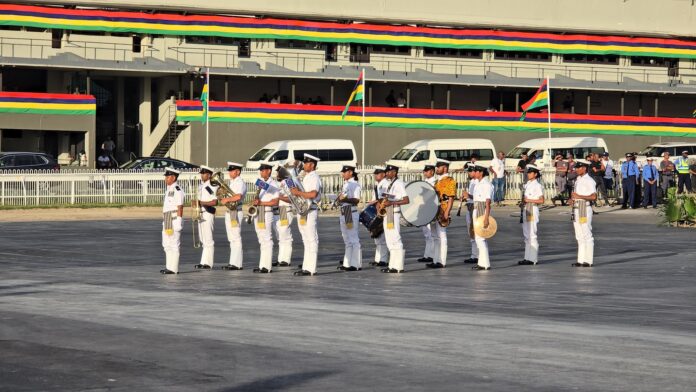
This is the invisible infrastructure of India’s maritime engagement – and the port call that INS Trikand made to Port Louis in the second week of March was another layer being added to it. The visit coincided with Mauritius celebrating its 58th Independence Day and 34th year as a republic, and Indian naval personnel participated visibly in the National Day parade on March 12. But the week’s real work was the training conducted aboard the frigate for Mauritius National Coast Guard personnel.
Watchkeeping procedures. Firefighting drills. Damage control exercises. These are skills that degrade without practice and that are tested most severely in the circumstances least conducive to thinking clearly — fires, flooding, equipment failures, far from shore. The value of running these drills with Indian naval personnel is not just competence transfer but coordination: learning how the other service communicates, where it places responsibility, and how it escalates decisions.
The material dimensions of India’s maritime support to Mauritius are well documented. The interceptor boat, the Dornier aircraft, the coastal surveillance radars, the hydrographic survey assistance, and the Agaléga Island facilities inaugurated in early 2024 — together they have extended Mauritius’ reach across an EEZ of 2.3 million square kilometres that the island nation is responsible for monitoring. The joint EEZ surveillance that INS Trikand conducted with CGS Valiant after leaving Port Louis on March 13 is a regular expression of how this infrastructure is used in practice.
India’s regional training investment provides scale for understanding what these bilateral engagements add up to. Five hundred and sixteen naval officers have been trained over nine years — a figure that represents not just skills delivered but relationships formed, an entire generation of a partner navy that has spent extended time learning alongside Indian counterparts. The same logic applies to Mauritius, where training contacts aboard Indian warships accumulate over successive deployments.
The stakes for Mauritius are concrete. Maritime activity accounts for over ten per cent of the country’s GDP and supports approximately 10,000 jobs beyond the tourism sector. Illegal fishing, drug trafficking, and piracy represent direct threats to this economic base. The capacity to detect, track, and respond to these threats in real time — across 2.3 million square kilometres — is not something a small island nation can build without assistance.
India’s MAHASAGAR vision frames its role in the Indian Ocean as that of a partner in shared stewardship rather than a dominant power offering patronage. The distinction matters for smaller states that are sensitive to sovereignty and wary of dependence. The training model — which builds local capacity rather than substituting for it — is consistent with this framing in ways that equipment provision alone is not.
When INS Trikand sailed away from Port Louis, the island’s national day celebrations were behind it, and the operational calendar was ahead. The Mauritian officers who had spent a week training on the ship would return to their regular duties with a different set of reflexes. In the Indian Ocean, where the next storm, the next trafficking vessel, and the next humanitarian crisis are always somewhere over the horizon, that preparation is rarely wasted.
