

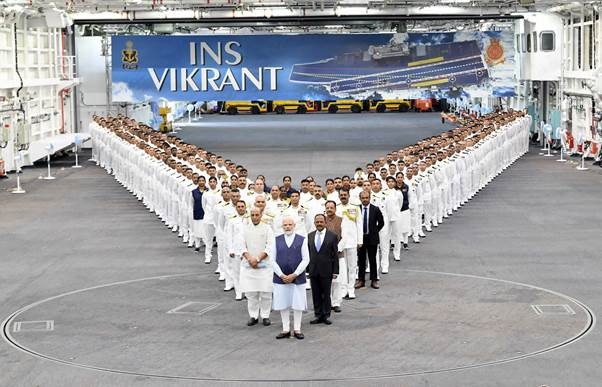
The most common argument against aircraft carriers is that a single submarine can sink one. The argument is accurate in isolation. It is operationally misleading when applied to how carrier battle groups actually operate, and strategically convenient for navies that cannot afford carriers. India’s naval planners have a different read of the historical record, and the historical record supports them.
No fleet carrier has been sunk in combat since the Second World War.
The last was the Japanese carrier Shinano, torpedoed by USS Archerfish on 29 November 1944 — a vessel sunk on her maiden voyage before she had ever deployed as a combat carrier, a detail that underscores the operational immaturity of the threat conditions under which she was lost. In the eight decades since, submarine technology has advanced enormously. So has carrier battle group anti-submarine warfare. The tally, as it stands, belongs to the carriers.
A modern carrier does not sail alone. INS Vikrant, when deployed as part of a carrier strike group, operates within a layered protective screen that includes dedicated anti-submarine warfare frigates, organic helicopter assets, and coordination with shore-based maritime patrol aircraft. India operates P-8I Poseidon maritime patrol aircraft — the same platform used by the United States Navy — each capable of sustained ocean surveillance across vast stretches of sea. These aircraft carry torpedoes, sonobuoys, and acoustic processing systems designed to detect, track, and engage submarines before they reach the attack range of the carrier.
India’s Kalvari-class submarines, the Scorpène-derived conventional fleet, contribute to carrier group defence in a complementary way. Submarines deployed ahead of a carrier’s transit route can sanitise a corridor, driving off or tracking any threatening boat before the carrier enters the area. This is standard naval practice and part of what makes the “one submarine, one carrier” formulation a thought experiment rather than an operational plan.
The Falklands War of 1982 is the most instructive modern case study. Britain operated two light carriers, HMS Hermes and HMS Invincible, as the centrepiece of the task force that retook the islands. Argentina operated a conventional submarine, ARA San Luis, which conducted three attacks on British ships during the conflict — on 1 May, 8 May, and 10 May.
All three failed, partly due to torpedo malfunctions and partly due to the effectiveness of British anti-submarine operations. The submarine threat was real. It was managed. Britain lost HMS Sheffield to an air-launched Exocet missile fired from an Argentine Super Étendard, not to a submarine torpedo. That loss was partly a consequence of insufficient air cover available to a task force operating without a full fleet carrier — the very capability stretched thin by the distances involved.
The lesson of the Falklands cuts against the anti-carrier argument, not for it. Sheffield burned because air cover was inadequate. The absence of sufficient carrier-based air power cost British lives. The presence of a submarine did not sink a carrier.
India’s maritime patrol aircraft provide multi-layer detection and engagement coverage that any approaching submarine must penetrate before reaching the weapons range of Vikrant. The combination of forward submarine screening, surface ASW frigates, organic helicopter coverage from the carrier herself, and land-based maritime patrol aircraft creates a threat environment around the carrier group that is significantly more demanding than the “fire torpedo, sink carrier” model that anti-carrier arguments depend on.
This does not make a carrier invulnerable. Nothing is. But it establishes that the operational calculus is far more complex than the simple version of the argument implies. The navies that have tested this calculation most extensively — the United States and the Soviet Union through decades of Cold War anti-submarine exercises — concluded that carrier battle groups, properly screened, are extremely difficult targets.
The Soviet Navy built an enormous submarine fleet partly around the objective of defeating American carrier groups in wartime. It never sank one, even in exercises designed specifically to test that objective at its operational limits.
For any regional actor in the Indian Ocean attempting to use the submarine threat as a deterrent against Indian carrier operations, the question is not whether submarines can threaten carriers in theory. It is whether they can do so against a layered Indian ASW screen, maritime patrol coverage, and a forward Kalvari screen operating simultaneously. That is a different and considerably harder problem.
