

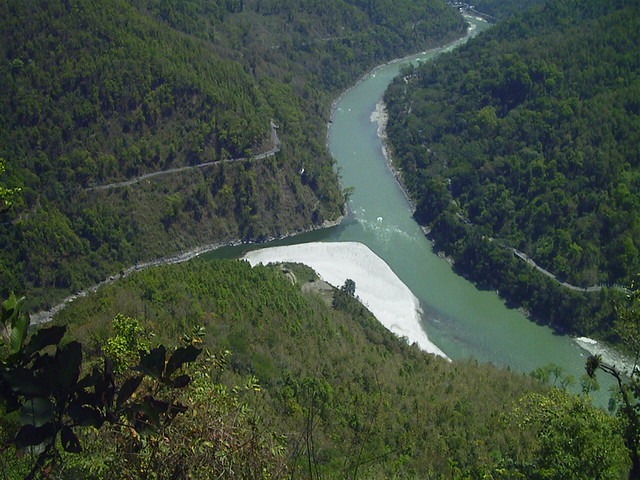
When Bangladesh’s interim Chief Adviser Muhammad Yunus asked China to draft a 50-year master plan for the country’s river and water systems during his March 2025 Beijing visit, most observers read it as pragmatic statecraft: a small nation seeking expert help while watching Beijing’s Medog Hydropower Station take shape upstream on the Yarlung Zangbo. What got less scrutiny was the structural implication buried inside the request. Bangladesh wasn’t just asking for a plan. It was inviting China to author the architectural logic of its most critical natural infrastructure for half a century.
The Teesta River Comprehensive Management and Restoration Project, a $1 billion undertaking involving reservoir construction, riverbed deepening, and embankment engineering, was formally opened to Chinese participation in the 2025 joint statement, with the Power Construction Corporation of China handed the job of finishing the project’s master plan. That’s not just a contract. It’s a design handover, and in infrastructure, design is destiny.
The Proprietary Standards Trap
Large-scale river infrastructure isn’t modular. When Chinese state-owned enterprises take on projects of the scale and complexity of the Teesta, or a future Jamuna management scheme, they bring engineering frameworks, software systems, sensor networks, and hydraulic modelling methods built inside China’s own technical ecosystem. These aren’t generic international standards. They’re proprietary architectures calibrated to Chinese equipment, Chinese supply chains, and Chinese maintenance protocols.
Bangladesh’s Padma Bridge, a flagship Belt and Road Initiative project, has already been described in Chinese state media as helping Beijing set technological and construction standards across South Asia. Once a standard gets embedded in a system as complex as a multi-phase river network, with its sluice gates, flood sensors, sedimentation monitors, and embankment stabilisation grids, any future partner looking to expand or upgrade it has to either adopt those standards or absorb a steep transition cost.
A contractor from Japan, India, the EU, or a multilateral development bank wouldn’t be building on a blank canvas. They’d be building on top of a Chinese-drawn blueprint. That’s lock-in by design: each technical choice made in Phase 1 narrows the options available in Phase 2, and by the time a multi-phase river project reaches maturity, switching costs have compounded from a financial inconvenience into something closer to a structural impossibility.
The Workforce Pipeline Problem
Infrastructure dependency doesn’t live only in hardware. It lives in people. The 2025 joint statement included an Implementation Plan for hydrological data exchange on the Yarlung Zangbo-Jamuna River, a framework that, in practice, has Bangladeshi water engineers and hydrologists working in Chinese data formats, on Chinese monitoring instruments, interpreting outputs from Chinese modelling systems.
Training pipelines tend to follow. Bangladeshi engineers working on Chinese-designed river systems are increasingly likely to get their technical education, certification, and capacity-building from Chinese institutions, a pattern already visible in other countries that have taken on Belt and Road infrastructure. Over time this builds a workforce whose professional fluency is calibrated to Chinese systems, and once a generation trained on that infrastructure reaches senior posts inside Bangladesh’s Ministry of Water Resources, institutional preference for continuity over diversification becomes self-reinforcing without any need for outside pressure from Beijing.
The Phase Escalation Dynamic
A common assessment in Bangladeshi commentary holds that the country has no real near-term alternative to China for implementing the Teesta project, a conclusion shaped by India’s prolonged hesitation and the collapse of the Hasina government that had favoured New Delhi’s involvement. That’s a fair read of where things stand today, but it understates how the logic hardens over time.
China is currently involved in building 21 bridges and 27 power projects across Bangladesh, with roughly 670 Chinese companies operating in the country. At that density, Chinese river infrastructure won’t sit in isolation; it will be cross-linked with Chinese-built energy grids, transport corridors, and digital networks already in place. Each additional phase of the Teesta or a future Jamuna project deepens that integration, raises the cost of exit, and narrows the political room for Bangladeshi technocrats to make a credible case for alternative partners.
The Strategic Calculus
None of this requires a conspiracy. China doesn’t need to impose dependency. It only needs to show up consistently, offer financing when others hesitate, and get its technical standards embedded early. Bangladesh has a real infrastructure gap weighing on its growth prospects, and China has positioned itself as close to indispensable in filling it.
That indispensability looks categorically different once it’s institutionalised in river management, a sector that touches food security, flood resilience, and the livelihoods of tens of millions, compared with dependency in roads or power plants. The choices being made now about who designs Bangladesh’s rivers, whose standards govern the sluice gates, and whose institutions train the engineers aren’t merely technical decisions. They’re the architecture of a future negotiating position, and that kind of architecture, once built, is very hard to tear down.
