

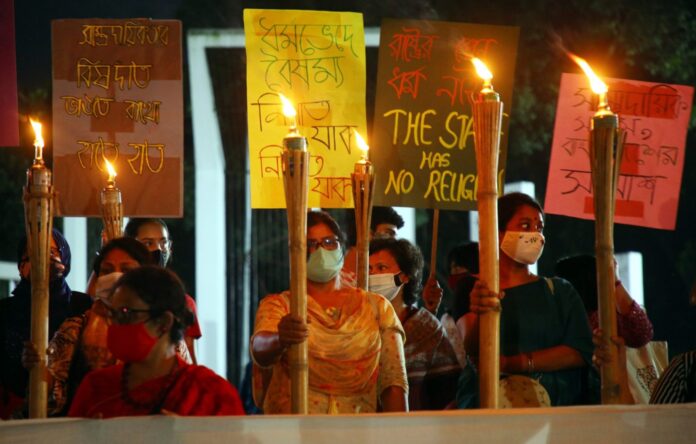
On 28 February 2013, a survivor in Rajganj Bazar, a village in Bangladesh’s Noakhali district, told Amnesty International that people taking part in a strike organised by Jamaat-e-Islami moved into the area and set fire to 30 houses, leaving 76 families homeless. The same day, in Daudkandi, Comilla district, a Hindu temple was vandalised and burned. Hundreds of kilometres apart, the two attacks shared a single trigger: the International Crimes Tribunal had that day sentenced Jamaat leader Delwar Hossain Sayeedi to death for war crimes committed during the 1971 Bangladesh Liberation War.
What followed was a pattern Bangladesh had seen before and would see again. Activists of Jamaat-e-Islami and its student wing, Islami Chhatra Shibir, attacked Hindu communities across the country in the days after the verdict. Hindu properties were looted, houses burnt, and temples desecrated and set alight. Amnesty International documented multiple such attacks, reporting that as many as 40 Hindu temples were vandalised within a week and that survivors directly identified the attackers as participants in Jamaat-organised processions.
The 2001 post-election violence produced an even larger wave of anti-Hindu attacks. After the BNP-Jamaat alliance won the October 2001 general election, violence swept Hindu-majority areas concentrated in south-western Bangladesh. A judicial inquiry commission, whose 1,078-page report was submitted to Home Minister Shahara Khatun in April 2011, found evidence of targeted violence against the Hindu community by around 25,000 people, including 25 ministers and members of parliament from the BNP-Jamaat alliance government. The report attributed the violence to differences in political philosophy, efforts to establish a communal ideology, and weaknesses in the caretaker administration of the time, and it described the persecution as an attempt to dent the country’s spirit of non-communalism and reintroduce Bangladesh as a communal country before the world. The commission acknowledged that most cases could not be fully investigated within the scope of a single inquiry, a finding that pointed, in measured language, to the near-total impunity that followed. The report was rejected by the BNP, which accused the investigation of being partisan.
That impunity is part of the documented story. Rights organisations tracking communal violence in Bangladesh have consistently observed that attacks on Hindus recur during elections, political transitions, or moments of religious controversy. The methods — arson, sexual violence, vandalism, intimidation — remain strikingly consistent across decades, as does the limited prosecution rate.
In January 2014, ahead of the tenth general election, around 250 to 300 activists of Jamaat-e-Islami and the BNP, armed with sharp weapons and sticks, attacked the Hindu-majority village of Malopara in Jessore’s Abhaynagar upazila after residents defied a boycott and cast their votes. They vandalised about 130 houses and set roughly 10 alight, looting valuables in the process. Around 600 Hindu residents fled across the Bhairab River to escape the assault. At least six people were injured. Seven Jamaat and BNP members were arrested in connection with the attack.
The ideological dimension runs through Jamaat’s own history. During the 1971 Liberation War, Jamaat-e-Islami supported the Pakistani military. Al-Badr, the militia accused of killing hundreds of Bengali intellectuals in the final days before independence, was formed from members of Islami Chhatra Sangha — Jamaat’s student wing at the time. That organisation was later reorganised and renamed Islami Chhatra Shibir in 1977. The history of organised violence against civilians did not disappear when Bangladesh was formed; it was carried into the post-independence political environment through Jamaat’s continuing presence as a party and through Shibir, which security agencies and human rights bodies have repeatedly linked to violent and, at times, extremist activity.
From 2013 to 2014, Bangladeshi authorities arrested thousands of Jamaat members and Shibir activists in connection with the unrest. In August 2013, the Bangladesh High Court cancelled Jamaat’s electoral registration, ruling that the party’s charter — which places religious authority above the democratic process — was incompatible with the constitution; the Supreme Court upheld that ruling days later. The party’s ideological infrastructure, its language of religious exclusion, and its capacity to mobilise street action against minorities during moments of political stress continued operating despite the loss of its registered political status.
What the documented attacks from Noakhali to Comilla to Malopara show is a pattern of communal violence that maps onto Jamaat’s political mobilisation. The fires set in Hindu localities after election results, after court verdicts, after Jamaat-called strikes, each followed a moment when the party had cause to demonstrate power or vent grievance. The rhetoric precedes the violence. The violence leaves temples in ash.
