

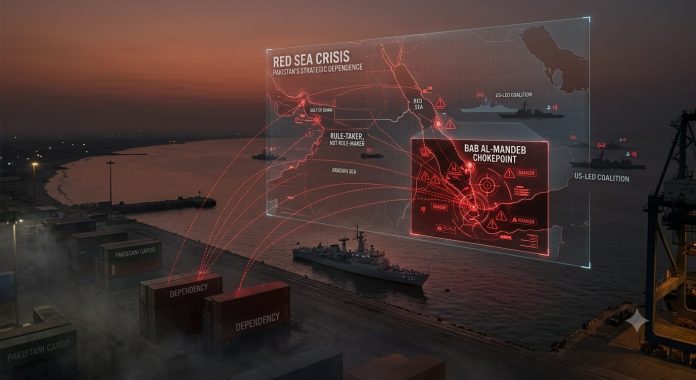
The deteriorating security situation in the Red Sea corridor this year exposed something more structural than any single incident: Pakistan simply does not have the independent naval reach to influence events in a theatre its own citizens depend on for their livelihoods.
Islamabad’s navy is a coastal and near-seas force by design and by budget. Its major surface combatants, submarines and maritime patrol assets are oriented around the Arabian Sea and, by extension, deterrence vis-à-vis India. Expeditionary reach into the Red Sea and Bab al-Mandeb chokepoint has never been part of that design, which leaves Pakistan reliant entirely on the security architecture built by others — the US-led coalition response to Houthi attacks and, separately, CMF patrols.
That dependence would matter less if it came with guaranteed influence over how those larger powers respond when Pakistani interests are affected. It does not. Pakistan is a rule-taker in this theatre, not a rule-maker — it can request information, seek diplomatic assurances, and hope its nationals are accounted for in evacuation planning run by others. It cannot independently redirect assets, negotiate safe passage on its own terms, or stage a rescue operation without depending on host-nation or coalition cooperation.
India’s position, while not equivalent to a blue-water power capable of unilateral Red Sea dominance, has at least demonstrated an ability to run independent evacuation and escort operations in adjoining waters when its own nationals were at risk — a track record built over successive crises in the wider West Asian and Gulf region. That capability gap between the two South Asian navies is now visible in stark terms.
The deeper issue for Pakistan is economic as much as military. A significant share of its overseas workforce — dockworkers, merchant crew, labourers transiting through Gulf ports — moves through exactly the corridor now destabilised by Houthi attacks on shipping. Remittances from this workforce are a meaningful pillar of Pakistan’s foreign exchange position. A security crisis in this corridor is therefore not a distant strategic abstraction for Islamabad; it is a direct hit to interests whose safety the state has limited independent ability to guarantee.
Pakistani officials have, in past statements, spoken of the country’s alignment with US-led maritime security initiatives as sufficient cover for these risks. The Red Sea crisis suggests otherwise. Alignment is not the same as capability. When the corridor turned dangerous, Pakistan’s options were to wait, watch and hope larger partners accounted for its interests — a posture that reveals dependence far more clearly than it demonstrates security.
